HOME / Departments / Earth and Planetary Sciences / Meteoritics and Experimental Cosmic Science
Meteoritics and Experimental Cosmic Science
-
- OKAZAKI Ryuji, Professor
- YAMAMOTO Daiki, Assistant Professor
- We study the origin and evolution of galaxies and planetary systems through scientific analysis of extraterrestrial materials and laboratory simulations of the relevant processes.
1. Planetary material science based on elemental and isotopic compositions of extraterrestrial materials
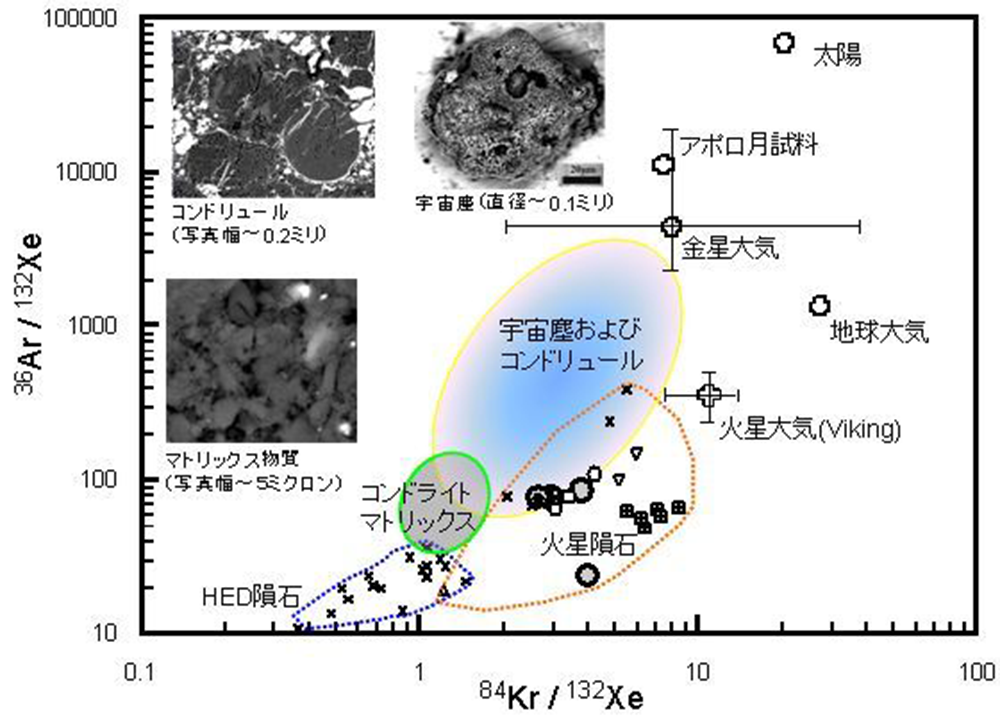
Chemical and isotopic compositions of the solar system materials are rich in diversity, and they could afford a clue to their origin and evolution. As an example, elemental compositions of noble gases in planetary materials are shown in the figure below. The composition of the sun plots at the upper right in the figure. Lunar soils, cosmic dust (micrometeorites), and some of chondrules have a composition located at the lower left from the sun. It is suggested that these materials contain noble fractionated solar gases, and they have been exposed to the solar wind. On the other hand, fine-grained materials in chondrites (called matrix) filling the interstices between chondrules and other inclusions contain a noble gas component, called Q gas, that is rich in heavy elements compared to the solar composition and thought to be the solar nebula origin. In addition, basaltic Martian meteorites contain a gas resembling the Martian atmosphere. It is thought that a part of the Mars atmosphere has been incorporated into the rocks at the time of impact on Mars. Based on chemical and isotopic compositions of noble gas and other elements, we aim to elucidate the origin and evolution of the planetary materials.
2. Experimental study under simulated solar protoplanetary disk conditions
The chemical characteristics and variation of the Solar System bodies can be interpreted as a result of the formation and evolution of primitive planetary materials through various chemical reactions in the protoplanetary disks. Investigations of chemical reactions that occurred in the protosolar disks in the laboratory and detailed comparisons of experimental samples with the extraterrestrial materials would make us possible to get information about the conditions under which extraterrestrial materials were processed. For this purpose, some heating furnaces capable to simulate protosolar disk-like low-pressure conditions were newly developed (an example shown in the figure below), and experimental analogs are heated under various heating conditions in the furnaces. We aim to constrain the physicochemical conditions of the protosolar disks based on the experimentally determined mechanism and kinetics of chemical reactions.