HOME / Departments / Earth and Planetary Sciences / Cosmic Evolution and Astrophysics
Cosmic Evolution and Astrophysics
-
- MACHIDA Masahiro, Professor
- Doris Arzoumanian※, Associate Professor
- ※ Institute for Advanced Study
- After the Big Bang, hydrogen and helium gas gathered under the gravity of dark matter in the expanding universe, leading to the formation of the first stars. These massive stars had short lifetimes and enriched the universe with heavy elements through supernova explosions. Later generations of stars, including stars like the Sun, formed from this enriched gas, and planets are thought to form in disks surrounding young stars. Our research aims to understand the formation of stars and planets throughout cosmic history. We conduct research on topics such as those introduced below.
Effects of Magnetic Fields on the Formation of the First Stars
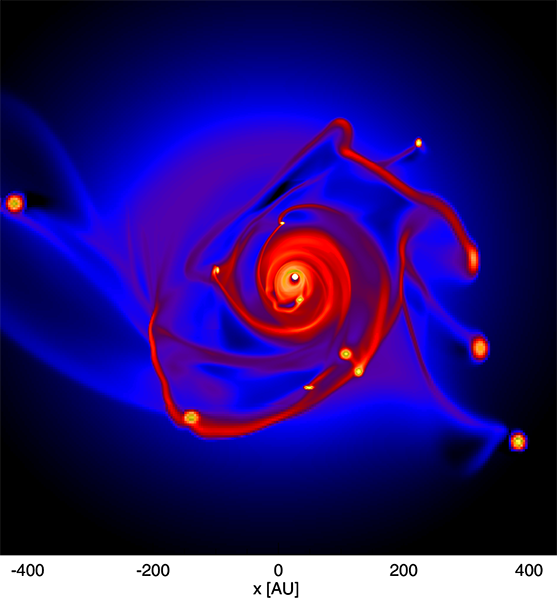
The first stars in the universe formed when primordial gas, composed mainly of hydrogen, collapsed under gravity inside dark matter halos known as “mini-halos.” Previous studies suggested that a rotating disk forms around the first protostar, and that fragmentation of this disk leads to the formation of multiple stars (Fig. 1). However, weak magnetic fields are also expected to have been amplified in the early universe. Numerical simulations that include magnetic fields suggest that they can suppress disk formation and fragmentation, potentially leading to the formation of a single massive star. Such massive first stars are thought to eventually evolve into supermassive black holes. In our laboratory, we study the formation of celestial objects in the early universe through theoretical and numerical approaches.
Understanding the Star Formation Process
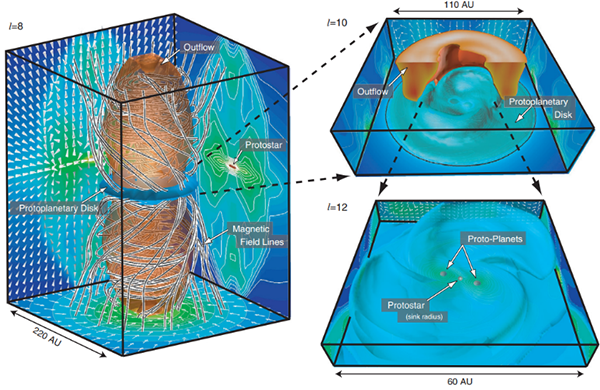
Stars form when dense gas cloud collapses under their own gravity. Fig. 2 shows the results of a supercomputer simulation of this process. In the left panel, the black and white lines represent magnetic field lines, while the orange regions show protostellar outflows. During the star formation process, protostars eject gas through the effects of magnetic fields, and these outflows can reach speeds greater than 100,000 km/h. The lower-right panel of Fig. 2 also shows the formation of two gas giant planets, similar to Jupiter, within the circumstellar disk.
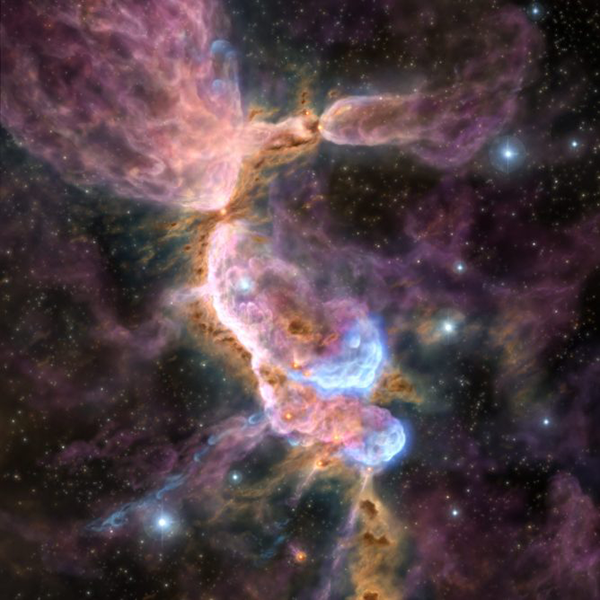
Fig. 3 presents a schematic view based on ALMA observations of the Orion star-forming region. Young protostars are located toward the upper left and upper right of the figure, and gas outflows can be seen emerging from them. In addition, a new star is forming near the tip of the outflow in the lower-right region. By combining numerical simulations and observations, we investigate the entire process of star and disk formation, from the collapse of molecular cloud cores to the formation of diverse planetary systems.
Formation of Planets and Planetary Systems
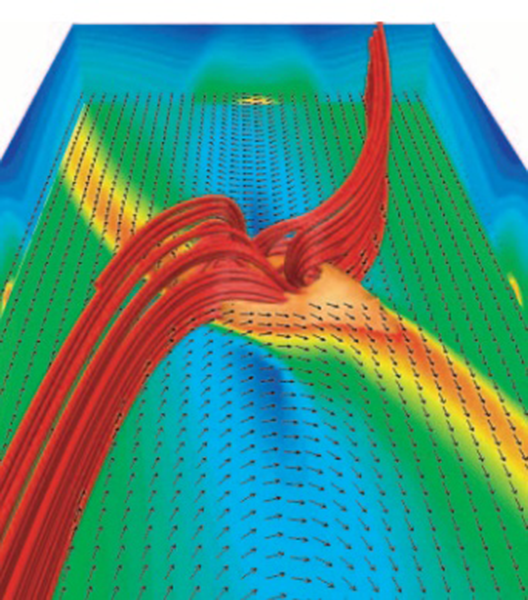
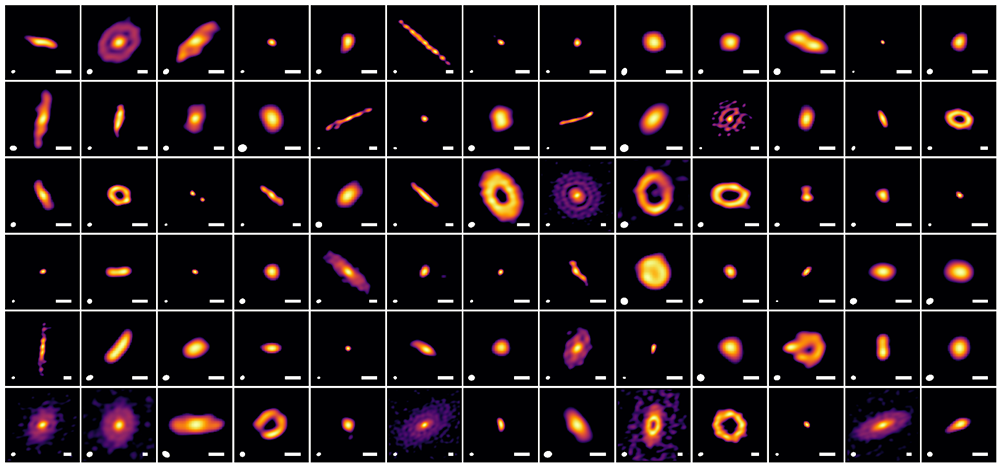
Planets are thought to form within protoplanetary disks surrounding newly born stars. Fig. 4 shows a simulation of the formation of giant gas planet and circumplanetary disk. The red lines represent gas streamlines, illustrating how gas flows onto the protoplanet from above. The orange disk region around the planet is be the site where satellites may form. Fig. 5 shows images of circumstellar disks around protostars observed with ALMA and reconstructed using sparse modeling techniques. The ring-like structures indicate regions where dust particles are depleted, while the elongated structures represent disks viewed edge-on. Variations within these elongated structures suggest that the disks contain complex internal features. Although the origin of these structures is not yet fully understood, they are believed to trace the early stages of planet formation. These observations also suggest that planet formation begins much earlier than previously thought.
In our laboratory, we combine numerical simulations and observations to investigate how stars and planetary systems form and evolve throughout cosmic history, from the first stars to present-day planetary systems.