
HOME / Departments / Earth and Planetary Sciences / Deep Earth Physics
Deep Earth Physics
-
- TAKAHASHI Futoshi, Professor
- Research subjects of our group focus on understanding the structure and dynamics of the deep interior of the Earth, planets and moons based on electromagnetism and geophysics. In particular, the center of the Earth called the core is our final frontier, which we cannot see directly. We study the core using observations of the geomagnetic field and numerical simulations of the magnetic field generation processes (geodynamo). We also study planets and moons such as Mercury, Mars, our Moon, Jovian and Saturnian icy moons. Investigation of the current internal structure of the bodies helps us understand their evolution histories and clarify their origin.
Numerical modeling of the geodynamo
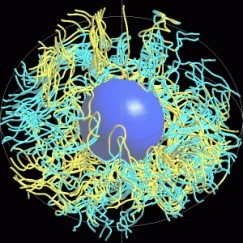
While it is well-known that the Earth has its own magnetic field, which is approximated by a bar magnetic centered in the Earth, it is not well-known why the Earth has the magnetic field. The origin of the geomagnetic field is a process of electromagnetic induction called “dynamo”. The Earth's dynamo works in the outer core, which mostly consists of liquid iron. Flows of such highly electrically conducting material can generate and maintain the magnetic field for billions of years. Since dynamo action is a highly non-linear problem, we cannot solve the equations analytically. Instead, we perform numerical modeling using high-performance computing (HPC).
Satellite-based magnetic field observation of the planets and moons
Magnetic field of other planets and moons are also our interest. Dynamos of the Moon and Mars are now extinct, but operated in the past. Remanence of the past dynamos are recorded in the crust. Thus, we could extract information about the evolution history by analyzing the crustal magnetic field observed by orbiting satellites. One of the currently most interesting subjects is the Mercury's magnetic field, which is maintained by dynamo in Mercury's core. In 2018, the Mercury's orbiter BepiColombo, with which magnetometers are equipped, was launched, and is getting into the orbit around the Mercury in the end of 2026. We study how the Mercury's magnetic field is at present, and is maintained based on observation and numerical modeling.